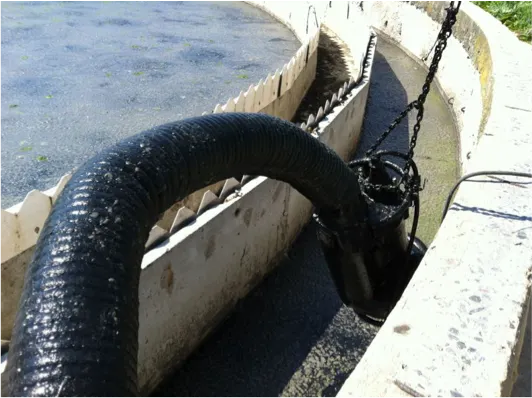
Solidpump TBS submersible grit pump with an agitator stirs up the settled grit right at the pump inlet and pumps it out mixed with water. The agitator is the pump's principal advantage: grit tends to compact into a hard layer at the bottom of the trap, and a conventional pump cannot dislodge this crust on its own. The agitator loosens the material first. Because grit is highly abrasive, the wear-exposed parts of Solidpump TBS pumps are manufactured from high-chromium iron rather than ordinary cast iron — although the impeller, agitator and seals remain wear components that require periodic replacement.
Comparison with Other Common Grit Removal Methods
- Compared with air-lift systems (widely used in aerated grit chambers): Solidpump TBS agitator pump consumes considerably less energy per ton of grit removed, breaks up compacted grit that an air-lift cannot shift, and performs better in deeper traps. Air-lifts are simple and robust, but they only lift grit that is already loose and are relatively energy-inefficient.
- Compared with chain-and-scraper mechanisms: Solidpump TBS pump is a single, self-contained unit that can be lifted out for servicing without draining the channel. Scraper systems place numerous chains and bearings in an abrasive environment, operate continuously and demand far more maintenance.
- Compared with grab cranes: Solidpump TBS pump operates continuously and automatically, with no need for a bulky overhead crane.
The Trade-Off
The agitator pump's main drawback is that it discharges grit mixed with a fair amount of water, which usually needs to be dewatered downstream — for example, by a grit classifier — and its wear parts have to be replaced from time to time. In return, it offers a single compact unit that handles compacted grit, operates autonomously, uses less energy than an air-lift, and is easy to service.
Other Potential Applications of Agitator Pumps at Wastewater Treatment Plants
Beyond grit traps, the same agitating principle makes Solidpump TBS and TBD series pumps useful wherever solids settle and compact into a layer at municipal WWTP’s that a conventional pump cannot handle.
- One example is pumping thickened or settled sludge. Sludge that has settled and consolidated at the bottom of a tank behaves much like packed grit — too dense for an ordinary pump to draw in. The agitator resuspends it into a pumpable mixture, allowing the pump to remove it without repeated stalling or clogging. Importantly, the agitator acts only locally, right at the suction inlet, so it does not stir up the tank as a whole. This avoids disturbing the settled sludge blanket and releasing suspended solids into the plant's effluent — a parameter that is closely monitored and tightly regulated at the outlet at WWTPs.
- Another is emptying and cleaning settling tanks before maintenance or repair. When a tank has to be taken out of service, the agitator pump can loosen and remove the accumulated sludge and grit from the bottom, breaking up the settled lower layer and pumping the tank down. This is a significant advantage, because taking a tank offline is usually a race against time: the faster it can be emptied and cleaned, the sooner it returns to service. A pump that clears a compacted bottom quickly, with far less manual cleaning, can be positioned as a way to shorten downtime on critical assets such as settling tanks and aeration basins — where every hour offline puts extra load on the rest of the plant.
Note: the TBS and TBD agitator pumps are not suitable for applications where high quantities of fibrous inclusions (rags, hair, toilet paper, etc.) are present. Before installing into municipal wastewater treatment plants, please make sure that there is screening equipment upstream.
www.solidpump.com